Date: Tuesday 10 Mar 2026 – 15:00 (Europe/London)
Speaker: Fraser Holloway, Postdoctoral researcher at University of Liverpool
Abstract
Within the field of nuclear spectroscopy, large-volume semiconductor detectors are a powerful tool to measure gamma-rays and infer the properties of nuclear matter. The design of these detectors heavily influences their signal response, and in turn can help us infer properties like the location and time of energy depositions. As nuclear physics moves to observing increasingly challenging decay paths in complex spectra, the development of intelligent processing algorithms that maximise the information we can get from detectors is paramount to furthering our understanding of the world around us.
This talk focusses on the development of the advanced signal simulation and processing pipeline used in the Advanced GAmma Tracking Array (AGATA) and how we utilise cutting-edge simulations of complex detector geometries and algorithms to match experimental signals and track gamma-rays thousands of times a second, identify multi-interaction events, infer timing properties and correct for experimental effects.
This seminar is now also available on YouTube https://youtu.be/sQRT5dPsjFA
Biography
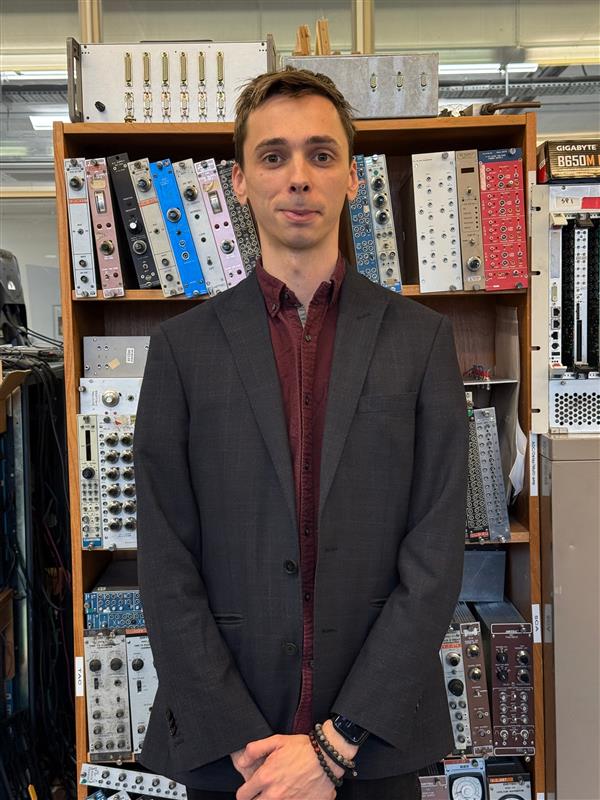
Dr Fraser Holloway is a Postdoctoral Researcher at the University of Liverpool specialising in the field of Nuclear Instrumentation. As part of his PhD, Fraser worked with colleagues from computer science to apply a variety of methods from Topological Data Analysis and Machine Learning disciplines in order contextualise the response of HPGe detectors and augment the position resolution achievable with real-time gamma-ray tracking.
In his current role as the head of Pulse Shape Analysis development for the AGATA collaboration, Fraser is in charge of advancing the simulation and analysis of AGATA's HPGe detectors, ensuring that AGATA can support Europe's physicists in analysing the most challenging nuclear reactions of our times. As part of his career, Fraser has worked alongside colleagues from industry, tackling problems ranging from medical imaging to nuclear security. His most recent work focuses on advanced contextual modelling of radioactive environments for automated radioactive source localisation and decontamination planning.